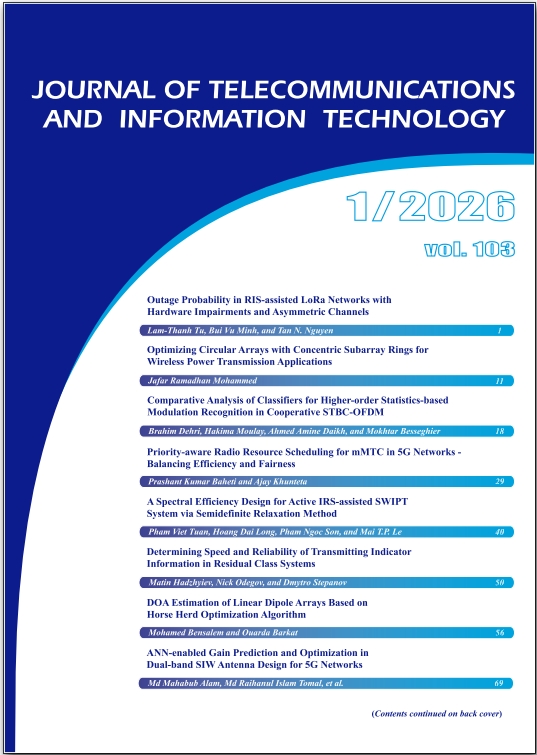
Comparative Analysis of Classifiers for Higher-order Statistics-based Modulation Recognition in Cooperative STBC-OFDM
DOI:
https://doi.org/10.26636/jtit.2026.1.2299Keywords:
automatic modulation classification, CFO estimation, CSI, DSTBC-OFDM, higher-order statistics, machine learningAbstract
Precise classification of modulation in cooperative relaying networks remains challenging in the presence of carrier frequency offset (CFO) and imperfect channel state information (CSI). This paper conducts a comprehensive comparative analysis of automatic modulation classification (AMC) methods for distributed space-time block-coded orthogonal frequency division multiplexing (DSTBC-OFDM) systems under these impairments. A unified simulation framework is developed that combines pilot-assisted CFO and CSI estimation with higher-order statistics (HOS)-based feature extraction. Four widely used machine learning classifiers, i.e. feedforward neural network, support vector machine, random forest classifier, and adaptive boosting, are benchmarked under identical channel and noise conditions. Monte Carlo simulations are performed across varying SNR levels and fading scenarios, enabling a fair assessment of classification accuracy, robustness to residual estimation errors, and relative computational complexity. The results provide practical insights into the strengths and limitations of each classifier in cooperative STBC-OFDM environments, offering valuable guidelines for selecting AMC techniques in future cooperative wireless systems.
Downloads
References
[1] H. Tayakout, I. Dayoub, K. Ghanem, and H. Bousbia-Salah, "Automatic Modulation Classification for D-STBC Cooperative Relaying Networks", IEEE Wireless Communications Letters, vol. 7, pp. 780-783, 2018. DOI: https://doi.org/10.1109/LWC.2018.2824813
View in Google Scholar
[2] G. Ryu, D. Jang, U. Jeong, and K. Ko, "BER Performance Analysis of Orthogonal Space-time Block Codes in Cooperative MIMO DF Relaying Networks", IEEE International Conference on Communications (ICC), Kansas City, USA, 2018. DOI: https://doi.org/10.1109/ICC.2018.8423038
View in Google Scholar
[3] W. Swasdio, C. Pirak, S. Jitapunkul, and G. Ascheid, "Alamouti-coded Decode-and-forward Protocol with Optimum Relay Selection and Power Allocation for Cooperative Communications", Journal of Wireless Communications and Networking, vol. 2014, art. no. 112, 2014. DOI: https://doi.org/10.1186/1687-1499-2014-112
View in Google Scholar
[4] A. Abdaoui, S.S. Ikki, and M.H. Ahmed, "Performance Analysis of MIMO Cooperative Relaying System Based on Alamouti STBC and Amplify-and-forward Schemes", IEEE International Conference on Communications (ICC), Cape Town, South Africa, 2010. DOI: https://doi.org/10.1109/ICC.2010.5501917
View in Google Scholar
[5] S. Yiu, D. Calin, O. Kaya, and K. Yang, "Distributed STBC-OFDM and Distributed SFBC-OFDM for Frequency-selective and Time-varying Channels", IEEE Wireless Communications and Networking Conference (WCNC), Paris, France, 2012. DOI: https://doi.org/10.1109/WCNC.2012.6214222
View in Google Scholar
[6] E. Chenguttuvan, L.P. Karuppiah, and K. Sakthisudhan, "Estimating Time and Frequency Under Imperfect Channel Knowledge Using ECM and SAGE Algorithms in Multi-relay Cooperative Networks", Journal of Wireless Communications and Networking, vol. 2025, art. no. 1, 2025. DOI: https://doi.org/10.1186/s13638-024-02418-9
View in Google Scholar
[7] T. Lin and F. Hwang, "Analysis and Design of Joint CFO/Channel Estimate Techniques for a Cooperative STBC-OFDM System", International Journal of Communication Systems, vol. 32, art. no. e3845, 2018. DOI: https://doi.org/10.1002/dac.3845
View in Google Scholar
[8] M. Besseghier et al., "Enhanced Estimation of Channel and CFO in FBMC/OQAM via ZFBMC-based Preamble", Wireless Personal Communications, vol. 139, pp. 1815-1836, 2024. DOI: https://doi.org/10.1007/s11277-024-11701-3
View in Google Scholar
[9] K. Hassan et al., "Blind Digital Modulation Identification for Spatially Correlated MIMO Systems", IEEE Transactions on Wireless Communications, vol. 11, pp. 683-693, 2012. DOI: https://doi.org/10.1109/TWC.2011.122211.110236
View in Google Scholar
[10] B. Xu et al., "Towards Explainability for AI-based Edge Wireless Signal Automatic Modulation Classification", Journal of Cloud Computing, vol. 13, art. no. 10, 2024. DOI: https://doi.org/10.1186/s13677-024-00590-3
View in Google Scholar
[11] K. Akhilesh and K. Vinay, "A Review of Diverse MIMO Antennas Design for Cognitive Radio Applications", AEU - International Journal of Electronics and Communications, vol. 200, art. no. 155930, 2025. DOI: https://doi.org/10.1016/j.aeue.2025.155930
View in Google Scholar
[12] M. Besseghier, A.B. Djebbar, A. Zouggaret, and I. Dayoub, "Joint Channel Estimation and Data Detection for OFDM Based Cooperative System", Telecommunication Systems, vol. 73, pp. 545-556, 2019. DOI: https://doi.org/10.1007/s11235-019-00622-3
View in Google Scholar
[13] Q. Xiao et al., "Research on OFDM Modulation Recognition Method Based on High-order Cyclic Cumulants and Neural Networks", IEEE 6th International Conference on Power, Intelligent Computing and Systems (ICPICS), Shenyang, China, pp. 712-716, 2024. DOI: https://doi.org/10.1109/ICPICS62053.2024.10796030
View in Google Scholar
[14] M. Ghogho and A. Swami, "Semi-blind Frequency Offset Synchronization for OFDM", IEEE International Conference on Acoustics, Speech, and Signal Processing (ICASSP), Orlando, USA, 2002. DOI: https://doi.org/10.1109/ICASSP.2002.1005151
View in Google Scholar
[15] X. Ma, M.K. Oh, G.B. Giannakis, and D.J. Park, "Hopping Pilots for Estimation of Frequency-offset and Multiantenna Channels in MIMO-OFDM", IEEE Transactions on Communications, vol. 53, pp. 162-172, 2005. DOI: https://doi.org/10.1109/TCOMM.2004.840663
View in Google Scholar
[16] R.N. Yang, W.T. Zhang, and S.T. Lou, "Joint Adaptive Blind Channel Estimation and Data Detection for MIMO-OFDM Systems", Wireless Communications and Mobile Computing, vol. 2020, art. no. 2508130, 2020. DOI: https://doi.org/10.1155/2020/2508130
View in Google Scholar
[17] B. Dehri, M. Besseghier, A.B. Djebbar, and I. Dayoub, "Blind Digital Modulation Classification for STBC-OFDM System in Presence of CFO and Channels Estimation Errors", IET Communications, vol. 13, pp. 2827-2831, 2019. DOI: https://doi.org/10.1049/iet-com.2019.0362
View in Google Scholar
[18] T. Liu and S. Zhu, "Joint CFO and Channel Estimation for Asynchronous Cooperative Communication Systems", IEEE Signal Processing Letters, vol. 19, pp. 643-646, 2012. DOI: https://doi.org/10.1109/LSP.2012.2210039
View in Google Scholar
[19] S. Huang et al., "Automatic Modulation Classification of Overlapped Sources Using Multiple Cumulants", IEEE Transactions on Vehicular Technology, vol. 66, pp. 6089-6101, 2017. DOI: https://doi.org/10.1109/TVT.2016.2636324
View in Google Scholar
[20] K. Ramadan, M.I. Dessouky, and F.E. El-Samie, "Joint Equalization and CFO Compensation for Performance Enhancement of MIMO-OFDM Communication Systems Using Different Transforms with Banded-matrix Approximation", AEU - International Journal of Electronics and Communications, vol. 119, art. no. 153157, 2020. DOI: https://doi.org/10.1016/j.aeue.2020.153157
View in Google Scholar
[21] R. Tang, X. Zhou, and C. Wang, "Kalman Filter Channel Estimation in 2x2 and 4x4 STBC MIMO-OFDM Systems", IEEE Access, vol. 8, pp. 189089-189105, 2020. DOI: https://doi.org/10.1109/ACCESS.2020.3027377
View in Google Scholar
[22] S. Salari and F. Chan, "Joint CFO and Channel Estimation in OFDM Systems Using Sparse Bayesian Learning", IEEE Communications Letters, vol. 25, pp. 166-170, 2021. DOI: https://doi.org/10.1109/LCOMM.2020.3024817
View in Google Scholar
[23] J. Jagannath, N. Polosky, and D. O'Connor, "Artificial Neural Network Based Automatic Modulation Classification over a Software Defined Radio Testbed", IEEE International Conference on Communications (ICC), Kansas City, USA, 2018. DOI: https://doi.org/10.1109/ICC.2018.8422346
View in Google Scholar
[24] S. Huang et al., "Automatic Modulation Classification of Overlapped Sources Using Multiple Cumulants", IEEE Transactions on Vehicular Technology, vol. 66, pp. 6089-6101, 2017. DOI: https://doi.org/10.1109/TVT.2016.2636324
View in Google Scholar
[25] A. Swami and B. Sadler, "Hierarchical Digital Modulation Classification Using Cumulants", IEEE Transactions on Communications, vol. 48, pp. 416-429, 2000. DOI: https://doi.org/10.1109/26.837045
View in Google Scholar
[26] K.A. Ahmed and E. Ergun, "Automatic Modulation Classification Using Different Neural Network and PCA Combinations", Expert Systems with Applications, vol. 175, art. no. 114931, 2021. DOI: https://doi.org/10.1016/j.eswa.2021.114931
View in Google Scholar
[27] I. Klyueva, "Improving Quality of the Multiclass SVM Classification Based on the Feature Engineering", 1st International Conference on Control Systems, Mathematical Modelling, Automation and Energy Efficiency (SUMMA), Lipetsk, Russia, pp. 491-494, 2019. DOI: https://doi.org/10.1109/SUMMA48161.2019.8947599
View in Google Scholar
[28] O.P. Awe, A. Deligiannis, and S. Lambothara, "Spatio-temporal Spectrum Sensing in Cognitive Radio Networks Using Beamformer-aided SVM Algorithms", IEEE Access, vol. 6, pp. 25377-25388, 2018. DOI: https://doi.org/10.1109/ACCESS.2018.2825603
View in Google Scholar
[29] K. Triantafyllakis, M. Surligas, and G. Vardakis, "Phasma: An Automatic Modulation Classification System Based on Random Forest", IEEE International Symposium on Dynamic Spectrum Access Networks (DySPAN), Piscataway, USA, 2017. DOI: https://doi.org/10.1109/DySPAN.2017.7920749
View in Google Scholar
[30] S. Yuan et al., "Efficient and Privacy-preserving Outsourcing of Gradient Boosting Decision Tree Inference", IEEE Transactions on Services Computing, vol. 17, pp. 2334-2348, 2024. DOI: https://doi.org/10.1109/TSC.2024.3395928
View in Google Scholar
[31] Y. Zhou et al., "A Modulation Recognition Method Based on Bispectrum and Ensemble Learning", 2nd International Conference on Computer Science, Electronic Information Engineering and Intelligent Control Technology (CEI), Nanjing, China, pp. 124-128, 2022. DOI: https://doi.org/10.1109/CEI57409.2022.9950111
View in Google Scholar
Downloads
Submitted
Published
Issue
Section
License
Copyright (c) 2026 Brahim Dehri, Hakima Moulay, Ahmed Amine Daikh, Mokhtar Besseghier

This work is licensed under a Creative Commons Attribution 4.0 International License.